
CALIFORNIA HEIGHTS HISTORY

Consisting of approximately 1,500 predominantly Spanish Colonial Revival homes built in the late 1920s, this is the city’s largest historic district. The boundaries of the California Heights district are Wardlow and Bixby Roads and Lime and Gardenia Avenues. This area of Long Beach was established in 1929 by Jotham W. Bixby out of agricultural lands of the Rancho Los Cerritos. You can also spy a few examples of Craftsman bungalows and Tudor Revival and Neo-Traditional homes of the late 30s and early 40s. Some older homes were relocated there from downtown Long Beach during the early development.
This is the City’s largest historic district. With nearly 1,500 homes, this area is a typical neighborhood that was developed following the City’s economic boom in the 1920s. Single-family homes in the Spanish Colonial Revival style predominate these streets, interspersed with other period revival styles such as Tudor Revival, Norman Revival as well as Neo-Traditional. Some homes, mostly California Bungalows, were moved into the area from other neighborhoods such as Signal Hill. The streetscape contributes to the district’s historical significance as well, with vintage street lights and large, mature trees.
Designated Streets:
- Wardlow Road
- Bixby Road
- Lime Avenue
- Gardenia Avenue
View the California Heights Historic District Ordinance, adopted by the City Council on Aug. 29, 2000.
Stepping Back in Time in California Heights
California Heights was first developed in the 1920s, when there was a growth spurt in Long Beach triggered by the discovery of oil on nearby Signal Hill. Earlier, most of the housing in Long Beach was closer to downtown.
The neighborhood was part of the grazing lands that once belonged to the Bixby Ranch, which was located on land that formerly was part of Rancho Los Cerritos. The elevation is somewhat higher than that of downtown Long Beach, hence the name.
California Heights, Long Beach, California
Location
California Heights is located north of Signal Hill, east of Los Cerritos, south of North Long Beach and Bixby Knolls, and west of Long Beach Airport. Shops and restaurants are conveniently located on Atlantic Avenue, which runs through the district.
Description
Until the early 1920s California Heights was part of the Bixby Ranch (now Rancho Los Cerritos) and was used primarily as grazing land. It was the discovery of oil on Signal Hill and the ensuing land boom in 1921 that caused the Jotham Bixby Company to subdivide and sell off lots in the California Heights tract.[1]
In 1927, California Heights included Chateau Thierry (the subdivision on the west side of California Avenue) and petitioned the City of Long Beach for paved streets, sidewalks, curbs and ornamental lighting.
The California Heights-Chateau Thierry area grew rapidly, with approximately 250 families moving into the neighborhood between 1925 and 1927. The area continued to attract new families, and by 1939 most of the building was complete.
Architecture
The district consists of approximately 1,500 homes. The predominant architectural style is Spanish Colonial Revival. Craftsman bungalows and Tudor Revival styles can also be found.
--------------------------
Tenderfoot
wins Young's $100 prize; newcomer from Colorado is lucky number holder in tract
drawing; section opened in glory blaze; California Heights backed even to
outshine Hill Crest.
Date 03 MAR 1913
Page 12
Column 1
Note Clipped.
Subject California Heights
Publisher Long Beach Press
Jotham Bixby Company
Phillip L Bixby, Selling Agent
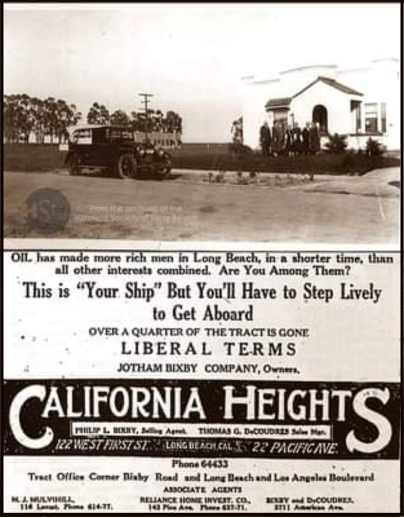
10/14/22, real estate ad in the Long Beach Daily Telegram June 1921, Oil discovered in Signal Hill Land was for Bixby Ranch lima bean and barley fields, labled as California Heights. Land was subdivided into lots and sold. Mineral rights enticed buyers who hoped to strike it rich.
Only the far SouthWest corner lay atop the oil field (Lime and 35th)Instead
of becoming industrial oil lands, utilities were lad and the homes of Cal
Heights neighborhood began to take shape in 1923. By 1927, hundres of homes had
been constructed.
California
Heights-Chateua Thierry Neighborhood Association was formed to petition the ciy
of Long Beach to spend osme of that booming black giold revenue on paved
streets and ornamental street lighting. Those lamposts still grace the
neighborhoods older streets today, restored by CHNA.
Hughes makes $250,000 buy from Bixby Company - tract to be Chateau Thierry.
Date 26 APR 1919
Page 7
Column 4
Note Cl.
Subject Chateau Thierry
Publisher Daily Telegram
California Heights builds for beauty; thriving center developed north of Wardlow road.
Date 04 DEC 1927
Page 1
Section C
Column 1
Note Photos. clipped & filed under California Heights.
Subject:California Heights
Chateau Thierry
Publisher: Press Telegram
Title Thousands inspect model home at 3602 Gaviota in California Heights Terrace.
Date 14 FEB 1937
Page 9
Section A
Column 5
Subject: Residences – Gaviota California Heights
Publisher Press Telegram
Title Tract opened; 185 lots sold in four hours.
Date 11 OCT 1922
Page 18
Column 4
Note Cl.
Subject California Heights
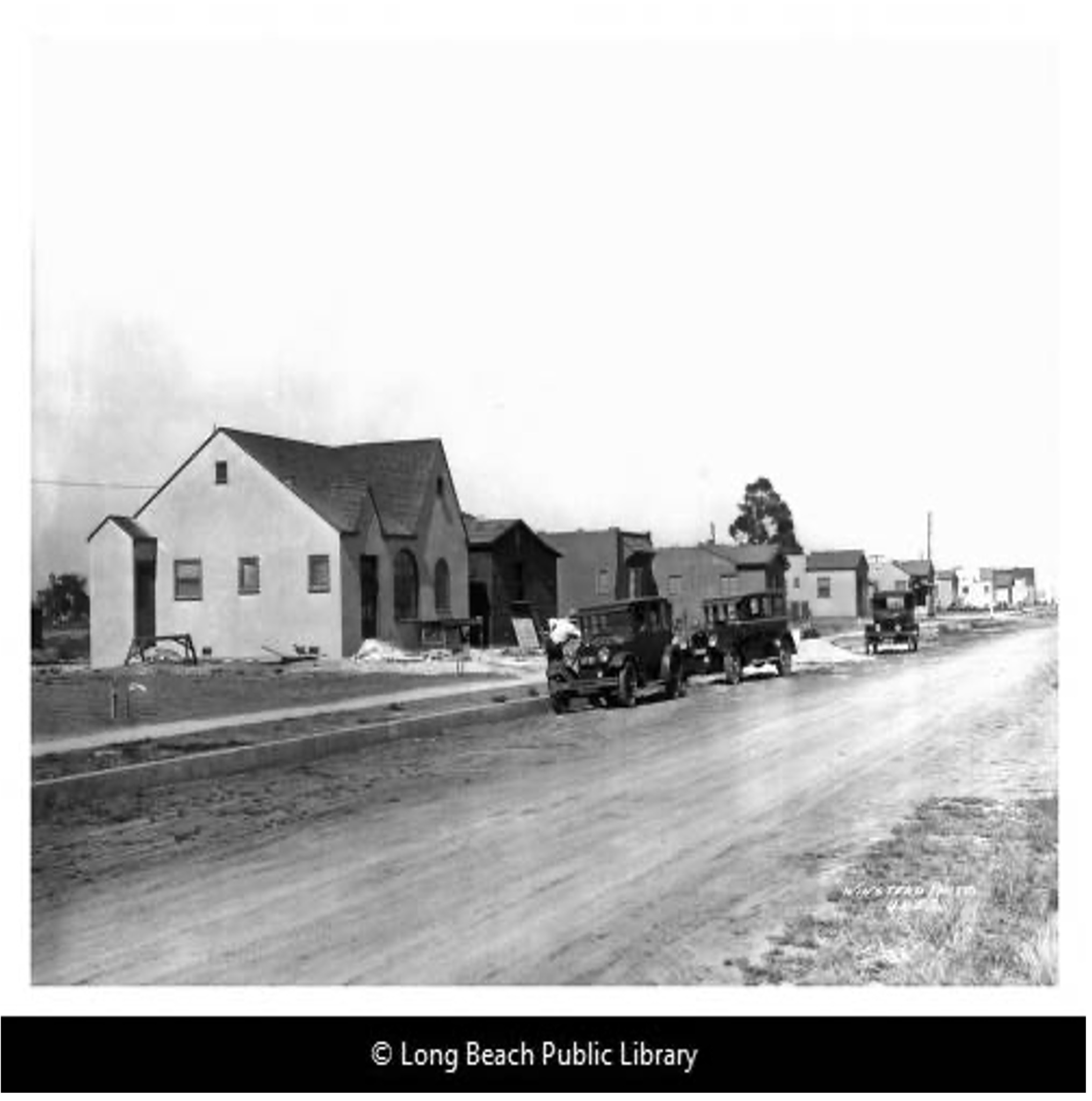
 Title Home under construction
Creator Winstead (3820C)
Date 1926
Subject Housing. Architecture. Building. Buildings.
Description Shown here under construction is a large new home, with small detached garage visible at left. The outer surface is covered with stucco, and the home has a chimney. A note on the image back states: "The oil derrick in the background puts it in the California Heights" [or]"Bixby Knolls area." In the distant left background, a few other residences are partly visible. A paved street with sidewalk and curb is in the foreground. Address is uncertain. DATE NOTES: 1926. ORIG. IMAGE: 8" x 10" B&W glossy print. NEGATIVE: No. KEYWORDS: Rig. (ss)
Source Winstead Co. donation
Identifier LBPL_3820WC.tiff
Type Image
Format jpeg
Relation California Heights
Rights For information about copyright and ordering images from the LBPL Digital Archive, see http://www.lbpl.org/history
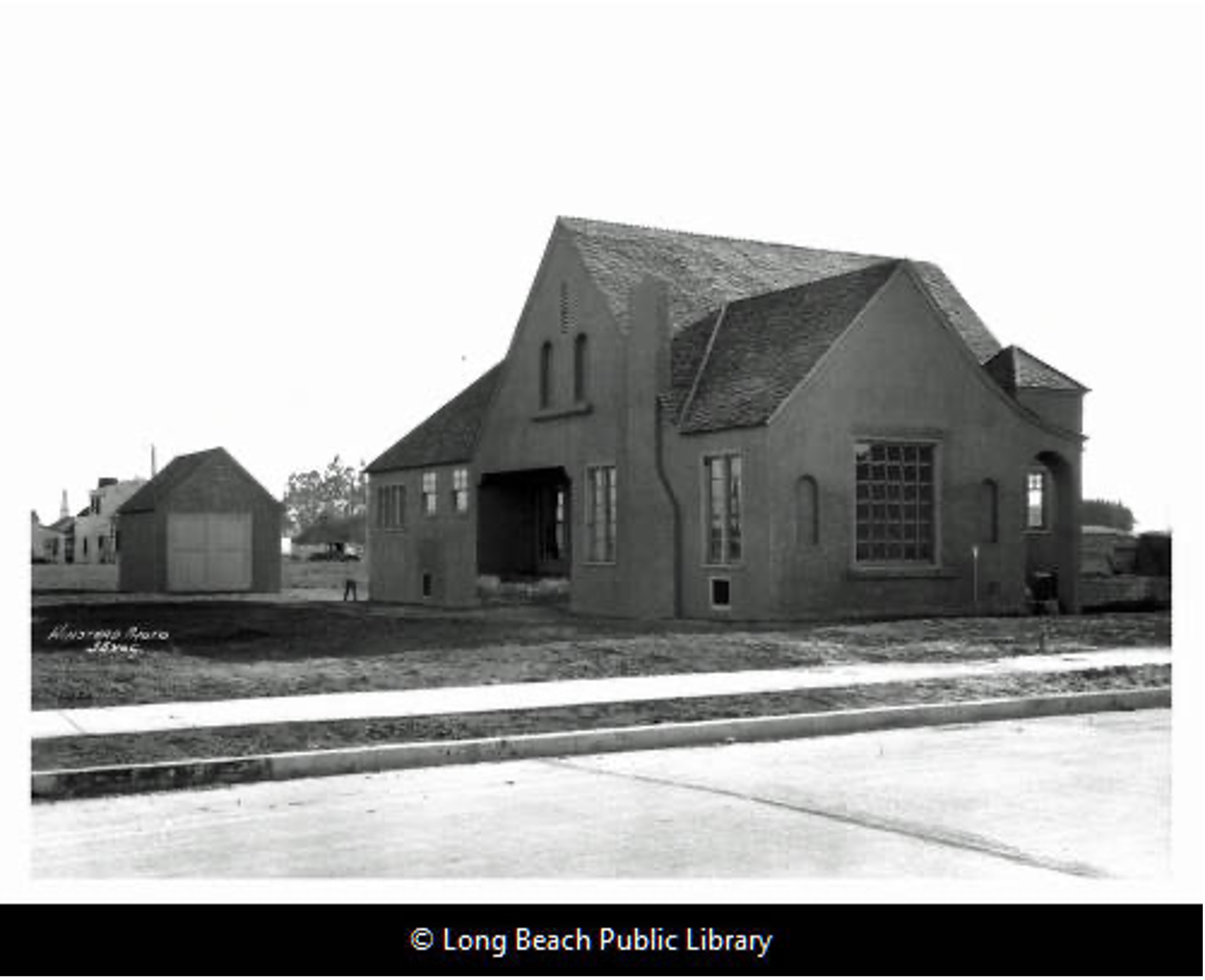
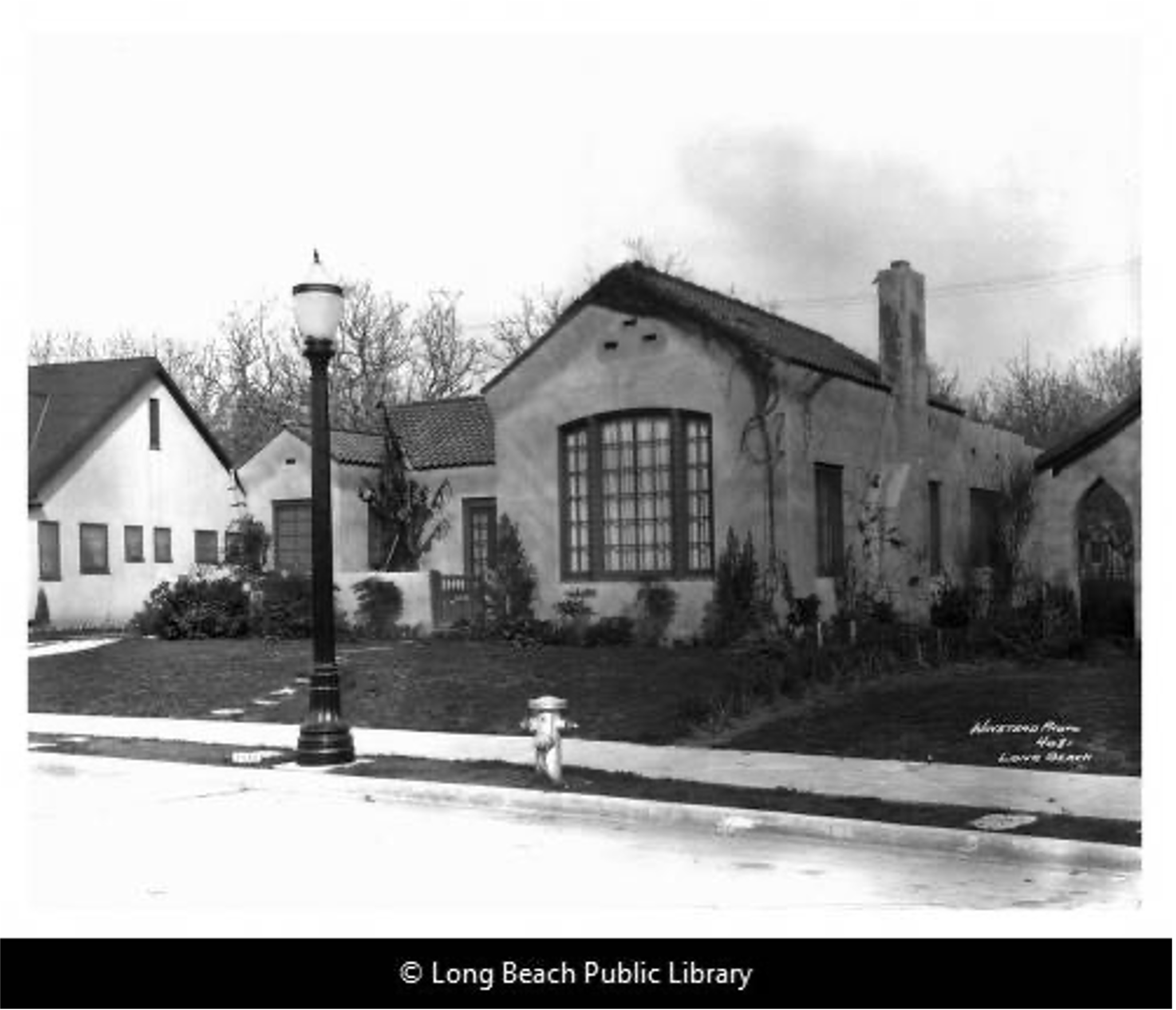 Title Spanish colonial
Creator Winstead (4081)
Date 1927
Subject Housing. Architecture.
Description This California Heights home with an address of "2323," features a red tile roof, a curved and mullioned front picture window, and a front patio space behind a small gate. Notes on image back state that this home is an example of "Spanish Colonial Revival" architecture. Homes on either side are also partly visible. In the foreground is a paved street surface, fire hydrant, street light, sidewalk, and curb. Street name is uncertain. DATE NOTES: Noted on image back. ORIG. IMAGE: 8" x 10" B&W glossy print. NEGATIVE: Yes. KEYWORDS: Development, tracts. (ss)
Source Winstead Co. donation
Identifier LBPL_5135.tiff
Type Image
Format jpeg
Relation California Heights
Rights For information about copyright and ordering images from the LBPL Digital Archive, see http://www.lbpl.org/history.
When Jotham Bixby died in 1916, the remaining 3,500 acres (14 km2) of Rancho Los Cerritos was subdivided into the neighborhoods of Bixby Knolls, California Heights, North Long Beach and part of the city of Signal Hill.
https://www.shhs90755.org/early-oil-history/famous-residents/the-bixbys.html
As the railroad brought more people and a diversifying economy, the decline of the tallow trade and a succession of floods and drought led Temple to sell the land in 1866 to the Flint Bixby Co. Jotham Bixby soon formed his own company and operated a sheep ranch until civilization began to encroach and the sheep industry declined. Jotham sold off and leased the land to developers and farmers and Cal Heights became a bean field until the discovery of oil on Signal Hill in 1921 spiked interest in the knolls.
The Jotham Bixby Co. placed 830 lots in new California Heights tract on sale October 10, 1922, marketing the properties to include oil rights. An ad in the Daily Telegram on October 14, 1922 stated, “You could stand on one corner of California Heights and with a 30-30 rifle shoot the lights off the top of dozens of [oil] rigs where gushers are spouting thousands of barrels of liquid gold daily.” Within four hours, 185 lots were sold and within 24 hours 250 more. Twenty-five of the lots were purchased by a syndicate of local businessmen who planned to drill for oil. Because the question of oil beneath the properties remained unsettled, it wasn’t until November 15, 1923 that the water, gas, telephone and electric mains necessary for building the homes were completed. Once these were in, it became evident that very little oil was under the tract and residential development began.
http://calheights.org/about-cal-heights/
California Heights Mural
Art Mortimer
Additional Artist Details Contributing Artists: Hoang Pham; Assisted by 10 Youth Assistants
This vibrant 12 x 46 foot mural depicts this thriving California Heights neighborhood at the Turn of the 20th Century. Mortimer, who is collaborating with the California Heights Neighborhood Association, recruited local elementary and high school students to assist with plotting and painting the mural. The mural depicts the rich agricultural heritage and ethnically diverse residents of this Long Beach community and marks the entrance to the California Heights historic district.